Dr Louisa Sun · Division of Infectious Diseases, Alexandra Hospital, Singapore
The Preparedness Lab
Flatten the Curve... for Learning
Interactive tools for teaching public health, outbreak preparedness and response. Each one puts the learner in front of a decision, and then shows them what it cost.
Working under uncertainty, weighing containment against livelihoods and trust, judging when the evidence is strong enough to act: these are the hardest parts of outbreak response, and they are rarely learned well from being told about them. They are learned by deciding under pressure and then living with the result, even when the result is simulated.
If you teach or design training in this field, everything here is free to use in non-commercial teaching, and most of it can be adapted to a different context, audience or pathogen.
11interactive tools, free for non-commercial teaching
4teaching programmes they were built for
3formats — multiplayer, self-paced, exercise series
Teaching tools
Built to make learners decide
The tools here are proof of concept as much as finished products. Each one started from a specific teaching problem: a concept that wasn't landing, a case study that deserved more than a lecture slide, a skill that could only be built through practice.
They have been used in postgraduate classrooms and professional training settings, and adapted for different regional contexts and audience levels. The list of problems that would suit the same treatment is a good deal longer than what is here so far.
Coverage of the course of an outbreak, by toolShow figureHide figureEach bar marks the part of an outbreak that the tool covers, from the first signal to recovery. The exercise series covers the whole course because its cases are drawn from the history of public health, and several of them are not outbreaks.
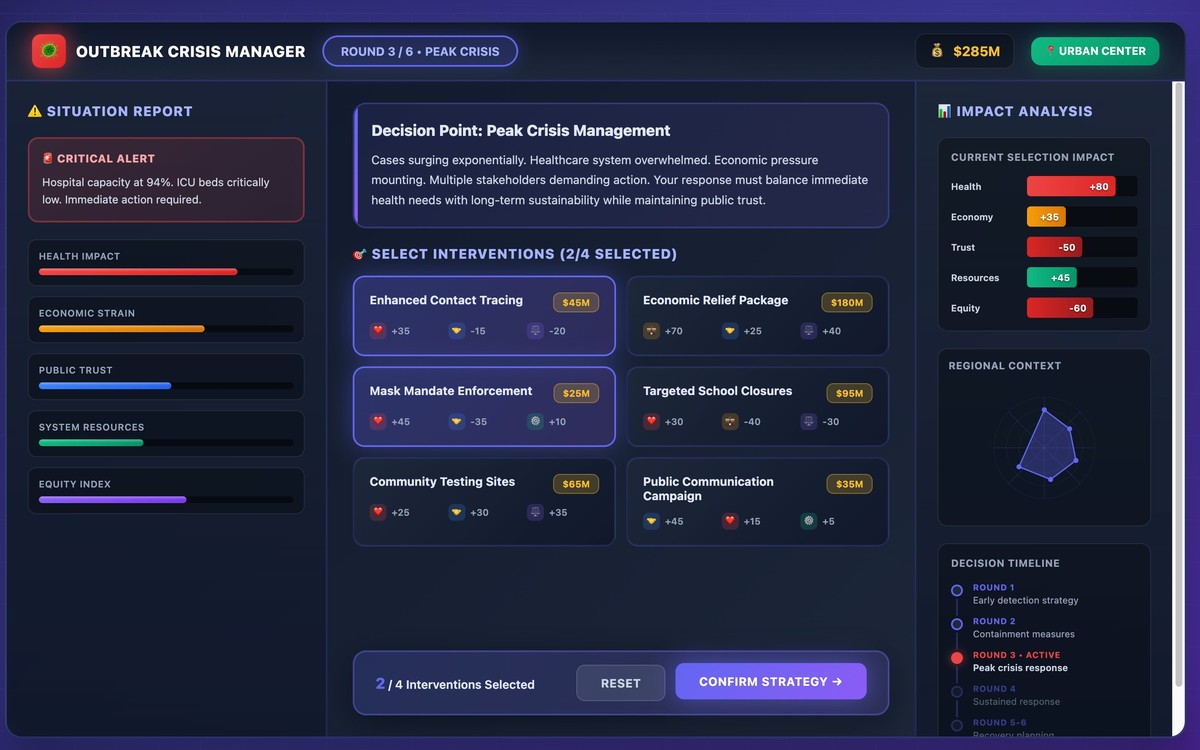
The simulation runs for six rounds, which follow the outbreak from the first unexplained cases to the end of the emergency. In each round the player selects non-pharmaceutical interventions within a budget, and each intervention has effects on five measures: health, economy, public trust, resources and equity. The five regions differ in population, economy, vulnerabilities and political constraints, and the same intervention therefore has different effects in different regions. Three stakeholder groups make requests with deadlines, and misinformation events occur in some rounds.
The interventions that reduce transmission most also carry the largest economic and social costs, and a response that is sound on the evidence can lose the region's political support.
Design logic
Effects are shown as directional arrows rather than as points, so that the player reasons about trade-offs rather than optimising a visible score. Evidence strength, regional fit, preparedness, stakeholder escalation and misinformation all modify what an intervention costs or achieves. The single-player edition ends early under two conditions: epidemic overload, when hospital capacity is exceeded, and loss of political mandate, when the regional assembly withdraws the emergency powers.
Format
The single-player edition runs in the browser, without installation or accounts. In the facilitated multiplayer version, five regional teams play in one room with timed rounds and a facilitator's view.
Features and licence
Stakeholder pressure systemThree constituencies escalate demands across rounds and can block specific interventions if neglected.
Preparedness consequence engineEarly-round decisions carry forward, creating region-specific benefits or penalties in later phases.
Evidence-tier frameworkInterventions are tagged by strength of evidence, rewarding evidence-based reasoning.
Misinformation challenge mechanicActive misinformation scenarios disrupt team strategy mid-round.
Community-led alternativesEvery round includes zero-cost grassroots options alongside government interventions.
After-action debriefThe debrief reports the downstream consequences of each team's decisions across all six rounds.
Regional and pathogen parameters can be adapted to other outbreak scenarios. The engine has been re-themed once, into The Forest Edge.
Simulation · single-player and facilitated multiplayer
The Forest Edge
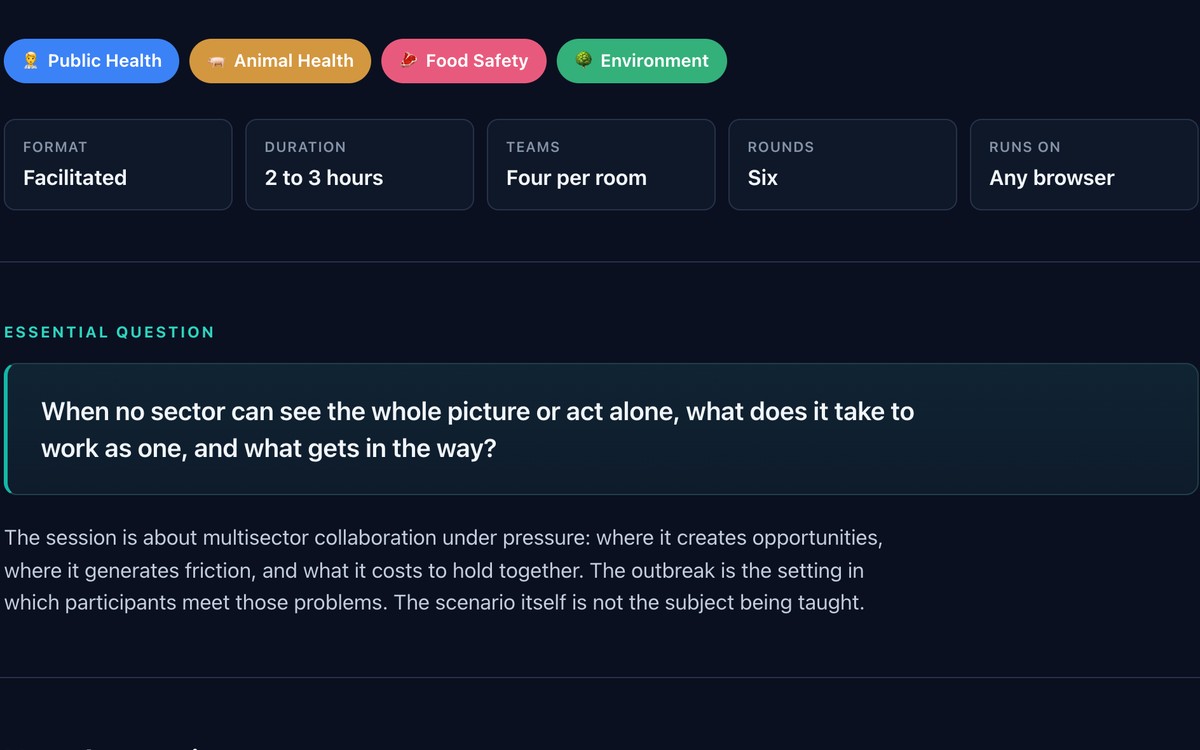
The Forest Edge is a One Health field investigation simulation in which four sectors, Public Health, Animal Health, Food Safety and Environment, respond to a zoonotic outbreak over six rounds.
Each sector holds only part of the information, field teams, budget and authority needed to control the outbreak, and confirming the source requires evidence that no single sector can obtain alone: the virus in human samples, the virus in the animal source, and an analytic study. In each round a sector reviews the situation and its own signals, resolves a crisis that presents two options, allocates field teams and budget to investigations and control measures, and commits. The round then resolves, and the report shows what changed and what the other three sectors did.
In the single-player edition the player holds one sector and the other three are run by the computer. Their leads report what they see and what they intend, and their findings appear on a shared board once they have investigated. Each round one of them makes a request with a deadline, and a request that is met leads to coordination in the following round. In the facilitated version, run as the scenario Spillover at the Forest Edge, four teams hold the sectors and the facilitator resolves each round on a board visible to the whole room.
Design logic
The effect of a control measure is proportional to what the room has confirmed about the source and to public trust, so a measure taken before the source is understood delivers only a fraction of its effect, and additional spending does not compensate. The outbreak, public trust and the economy are shared across the whole system and no sector has a score of its own, so a shortcut taken by one sector imposes costs on the other three.
Format
Single-player edition in the browser. The facilitated version runs for 2 to 3 hours with four teams and a facilitator; its materials comprise a run guide with per-round guidance and a debrief script, participant briefs and role cards, teaching decks, and a sourced evidence pack. The pathogen is not named to participants until the debrief.
Features and licence
Each team sees only its own sectorA team is shown only its own signals, resources and decisions. Information established elsewhere in the room reaches it only through communication.
Measures depend on the room's knowledgeA control measure taken before the source is understood delivers a fraction of its effect, and additional spending does not compensate for an incomplete investigation.
Severity, trust and livelihoods are tracked separatelyContainment achieved through coercion registers as lost trust and lost income, and low trust then reduces compliance with every subsequent measure.
Budget and field teams are finiteThere is one budget for the whole outbreak, a small number of field teams each round, and a share of a single national laboratory; budget spent early is unavailable at the peak.
Every option has a costEach round presents each sector with one forced decision in which both options carry a cost, and declining to decide carries a larger one.
Frameworks are named in the debriefParticipants play first; the frameworks are introduced in the debrief against decisions the participants have already made.
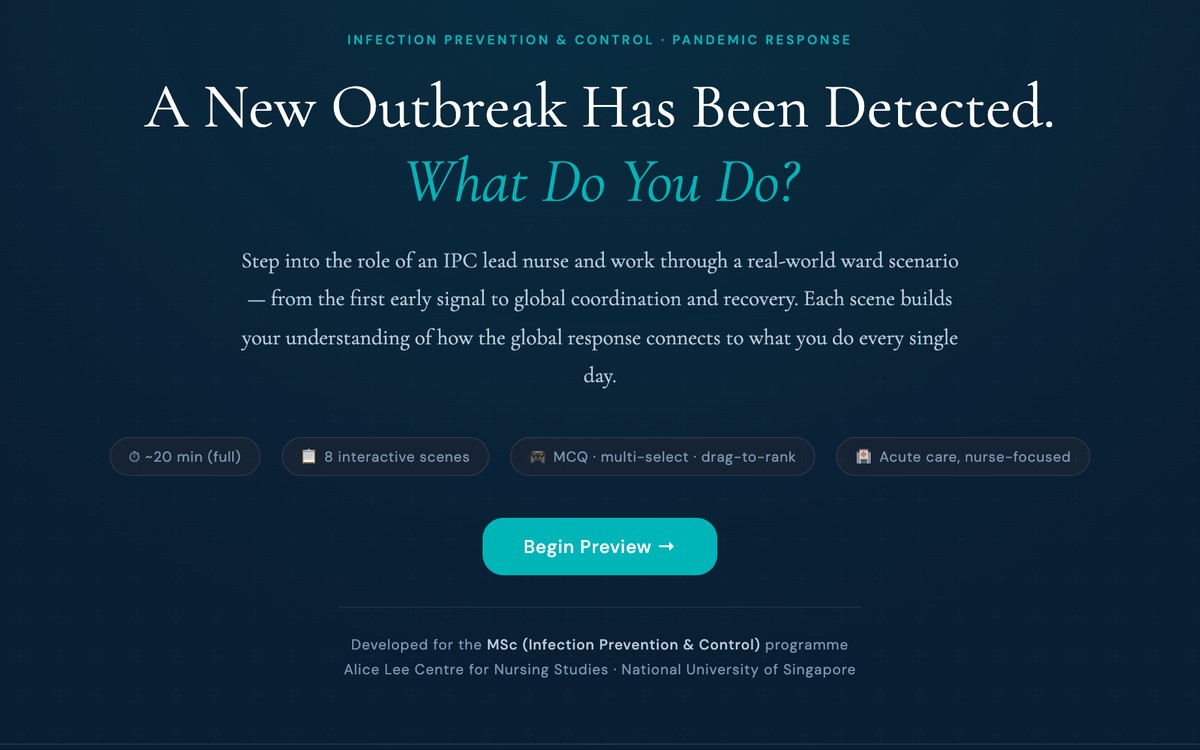
The player takes the role of the IPC lead nurse on a hospital ward and follows an outbreak through eight scenes, from the first ward signal, through preparedness, the response pillars, genomics and global coordination, to recovery. Each decision connects events on the ward to the national and global systems that act on them and return guidance to the bedside. The simulation was developed for the MSc in Infection Prevention and Control at the Alice Lee Centre for Nursing Studies, National University of Singapore.
Design logic
Each scene ends in a decision, taken as a multiple-choice or multi-select question or a drag-to-rank sequence, and the feedback after each decision states the key learning point. Expandable knowledge cards explain the concepts on which a scene rests, such as the Swiss cheese model and the International Health Regulations, at the point of use. The language and the scenarios are those of ward-based staff.
Format
Self-paced, about 20 minutes, in the browser. The public link is a preview in which scenes 1 to 3 are open; scenes 4 to 8 are available to enrolled students of the MSc programme.
Features and licence
8-phase scenarioFrom the first signal through to recovery, covering preparedness, response pillars, genomics, and global coordination.
MCQ & multi-selectKnowledge checks with detailed feedback and a key learning point after each decision.
Drag-and-drop sequencingA sequencing task traces how a ward report becomes global guidance and returns to the bedside.
Knowledge cardsExpandable panels explain core concepts, such as the Swiss cheese model, flattening the curve and the International Health Regulations.
Built for nursing educationAligns with IPC learning outcomes and uses language and scenarios familiar to ward-based staff.
Self-contained & self-pacedRuns entirely in the browser, for individual study or a facilitated group debrief.
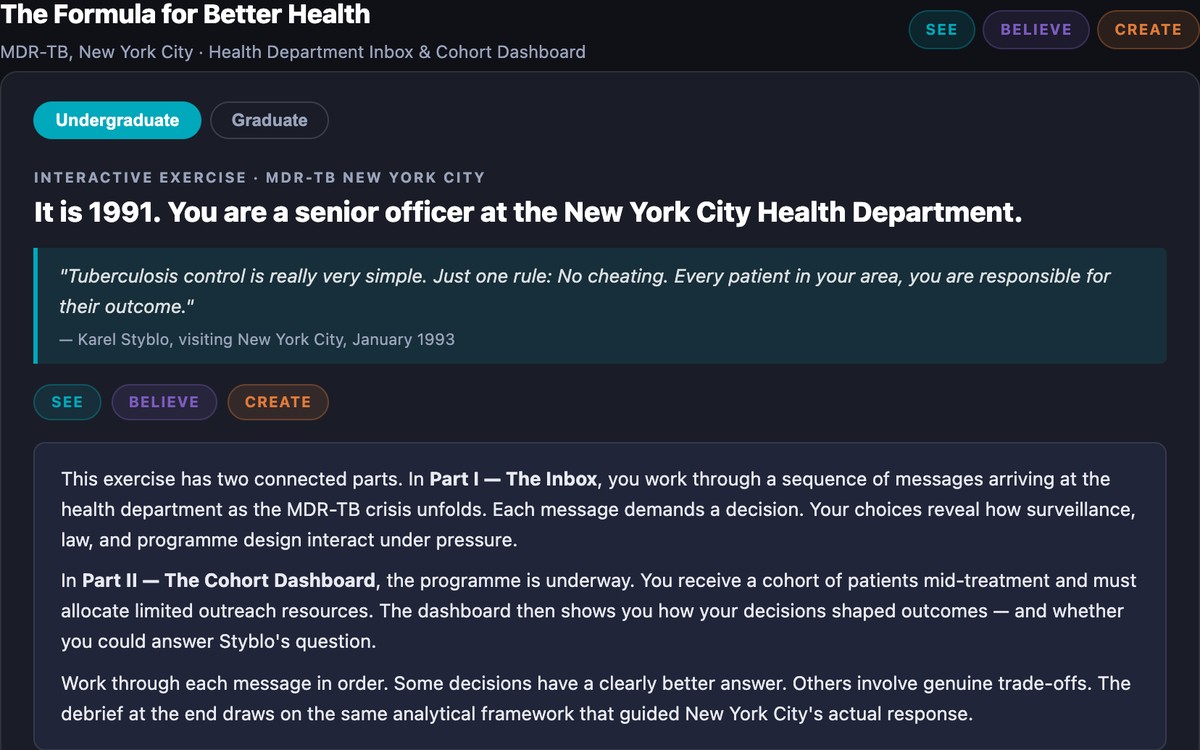
Each exercise places the learner in the position of a decision-maker in a documented case from the history of public health and requires a decision to be committed before the reasoning is revealed. The case studies and the teaching content are Dr Frieden's; the contribution here is the exercise architecture, which turns each case into a sequence of decisions. Each exercise runs in an undergraduate and a graduate mode on the same material and takes about 15 minutes, on its own or within a course.
Design logic
Learners commit a choice and record their assumptions before the reasoning is revealed, so that the debrief can be checked against their own reasoning. Decisions carry forward across the acts of a case, and a consistency check identifies contradictions between a learner's analysis and the design decisions that follow it. The inbox and cohort-dashboard formats reproduce the information environment of the decision-maker in the original case.
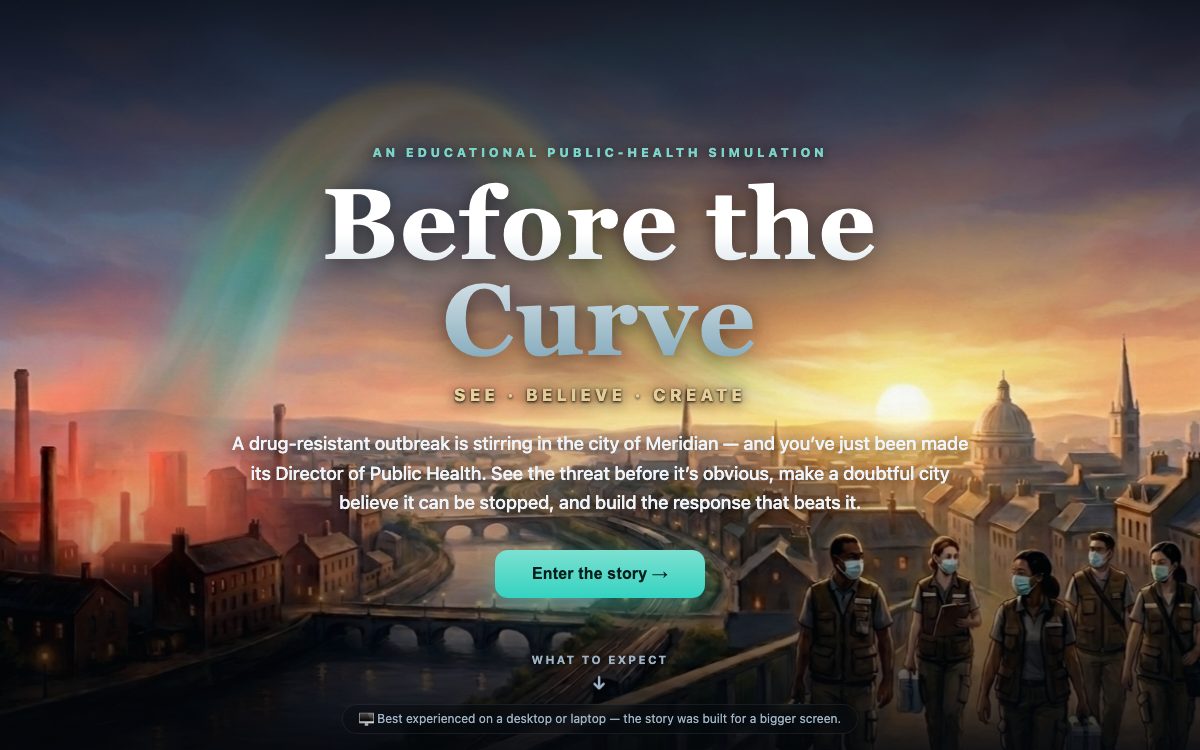
Before the Curve is a single-player narrative simulation of the public health response to a drug-resistant respiratory outbreak in a fictional city, with the player as its Director of Public Health. The three acts follow the See, Believe and Create framework of The Formula for Better Health.
The city, Meridian, has 600,000 inhabitants, and the player is appointed as the first cases appear in a single working-class district. In the first act, See, the player decides which weak signals to investigate and when the evidence is sufficient to act; in the second, Believe, how to build public and political confidence that the outbreak can be stopped; in the third, Create, how to design a response that is fast and fair, with each part of it assigned to a named person. Each decision is made by playing one card from a hand of options, after which the epidemic curve and the player's standing with the main characters are updated on screen. Decisions cannot be reversed, and their consequences carry through to the end.
Design logic
Every decision is committed before the reasoning behind it is revealed, and each decision corresponds to a principle from the book, whose page the player collects on completing it. The debrief traces the outcome back through the player's own choices.
Format
Self-paced, about 60 minutes in total, in three acts of roughly equal length, played in the browser on a desktop or laptop; progress is saved and can be resumed. The simulation is suitable for courses from introductory to graduate level and can be used as a standalone activity or alongside the existing case studies. No prior public health study is assumed, and technical terms are defined where they first appear.
Decisions are irreversibleNothing can be undone, and the consequences of early decisions persist to the end of the three acts.
Terms are defined at first useTechnical terms carry a definition on hover or tap.
Counterfactual curveThe player's epidemic curve is plotted against a do-nothing baseline, and the gap between the two is shown as cases prevented. During play the curve also carries a forecast that changes with each decision.
Progress is savedThe simulation saves at each scene and resumes at the same point.
Looking further
What else
Beyond what's here
The same approach applies wherever a learner needs judgement rather than recall. Some problems in public health training and education that would suit it:
Laboratory capacity and accreditation
Walking health workers through accreditation standards as an interactive decision sequence, rather than a static checklist or manual.
Public health workforce onboarding
Orienting new staff to outbreak protocols and institutional systems through scenario-based exercises that build judgment, not just familiarity.
Risk communication practice
Designing messages for different audiences, outbreak stages, and trust contexts, with feedback that surfaces the consequences of each choice.
One Health tabletop exercises
Cross-sectoral teams navigating a zoonotic spillover event, with mechanics that make the human-animal-environment interface operationally real.
Surveillance system design
Building a sentinel network under resource and time constraints, with competing priorities that force genuine tradeoffs.
Policymaker decision support
Translating outbreak modelling outputs and epidemiological evidence into decision-relevant formats for non-technical audiences.
Community and school-level education
Making epidemic dynamics tangible for younger or non-specialist audiences through simplified but structurally honest simulations.
Dr. Louisa Sun (MB BS, MMed (Int Med), MRCP(UK), MPH) is an infectious diseases and public health physician based in Singapore. She is Head and Consultant of the Division of Infectious Diseases at Alexandra Hospital, National University Health System, and a Visiting Consultant at the National Centre for Infectious Diseases.
Her clinical work spans infectious disease medicine, infection prevention and control, and antimicrobial stewardship. She has led outbreak response operations at the institutional level — including large-scale field response during the COVID-19 pandemic — and contributes to national public health policy across communicable disease governance and antimicrobial resistance. Globally, she is engaged in outbreak preparedness and response through the Global Outbreak Alert and Response Network (GOARN).
In education, she has contributed to the development and delivery of postgraduate programmes in infectious disease emergencies and infection prevention and control, and holds teaching appointments at the Yong Loo Lin School of Medicine, National University of Singapore.
Alongside this work, she develops interactive teaching tools for outbreak preparedness education — and is always looking for new problems worth solving.
Every tool here began with someone bringing a teaching problem: a subject matter expert, an educator, or an institution that could already see what wasn't working. If you have one, get in touch.
Commissions, partnerships, and adaptations for non-commercial use are all possible.